
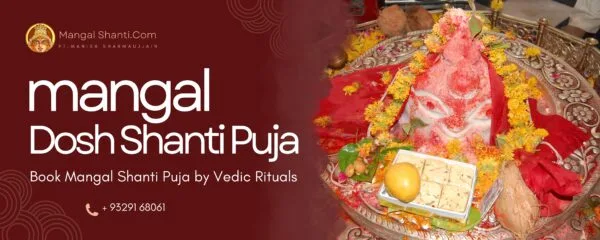
Mangal Dosh Puja Ujjain is a powerful Vedic ritual performed to neutralize the negative effects of Mangal Dosha (Kuja Dosha) in a person’s horoscope, which can affect marriage, relationships, and family life. Conducted at sacred locations like the Shipra Ghat in Ujjain, this puja involves chanting mantras, performing havans, and offering prayers to Lord Mangala and other deities to bring peace, harmony, and prosperity. Devotees believe that performing Mangal Dosh Puja Ujjain helps resolve obstacles in married life, strengthen marital bonds, and enhance overall well-being while aligning one’s planetary energies for a smoother, happier life.
What is Mangal Dosha (Mangalik Dosha)?
Mangal Dosh, also called Manglik Dosh or Kuja Dosh, is a condition in Vedic astrology that happens when the planet Mars (called “Mangal” in Hindi) is placed in certain houses of a person’s birth chart. The person born in such a condition is called “Manglik” or “Mangali”. This position is believed to be very unfavorable for marriage and overall well-being. This placement is believed to create a fiery and assertive energy that can lead to challenges in marriage and relationships, including delays, discord, and even health or financial issues.
How to Check Mangal Dosha?
To check whether Mangal Dosha is present in your Kundali or birth chart, you need to examine the placement of the planet Mangal. If Mars (Mangal) is placed in the 1st, 2nd, 4th, 7th, 8th, or 12th house of your birth chart (Lagna chart), it may create what is known as Mangal Dosha. This condition is believed to influence marriage and relationships, depending on Mars’ strength and its connections with other planets.
You should also check your Moon chart (Chandra Kundali) and Venus chart, as Mangal Dosha in these can also have influence. The most accurate way to determine Mangal Dosha is by using reliable astrology software, an online Mangal Dosha calculator, or by consulting an experienced Vedic astrologer. They can help you analyze all relevant charts, including the Navamsa chart (D-9 chart), for a complete understanding.
Types of Mangal Dosha (Manglik Dosha) in Vedic Astrology
Mangal Dosha is called by different names in different regions of the country and astrologers in different areas have different opinions about Mangal Dosha. Mangal Dosha is usually called by many names such as Manglik Dosha, Chunri Mangal, Chudamani Mangal, Kuj Dosha, Chandra Manglik, Double Manglik, Dwi Manglik, Pagdi Mangal, Pag Mangal and Anshik Manglik or General Mangal.
1. Chandra mangal (Chandra Mangalik) When Mangal Grah is positioned in the 1st, 4th, 7th, 8th, or 12th house of a person’s Moon chart (lunar horoscope), the individual is considered to have ‘Chandra Manglik Dosha’ its Anshik Mangalik dosha. Low (partial) Manglik Dosha: Mars in the first, second, fourth or twelfth house; it is considered mild and its effect may reduce with age or treatment.
2.Chuda Mangal Dosha (Choodamani Mangal Dosha) is a rare and significant yoga in Vedic astrology. It forms when Mangal Grah is positioned in the 1st, 4th, 7th, 8th, or 12th house (bhava) of the Lagna Kundli and is influenced or aspected by certain specific planets. but under certain circumstances it can also give auspicious results. High (full) Manglik Dosha: if mangal in the seventh or eighth house; it is considered strong and can cause serious delays or challenges in marriage.
3. Pagdi Mangal (Paag Mangalik) If a man has Mangal Grah positioned in the 1st, 4th, 7th, 8th, or 12th house in both his Lagna Kundli and Moon Kundli, he is considered a ‘Purna Manglik’ (Double Manglik). In such cases, the male native is specifically referred to as a ‘Pagdi Manglik’ (Paag Mangli) in Vedic astrology.
4. Chunari mangal If a woman has Mangal Grah placed in the 1st, 4th, 7th, 8th, or 12th house (bhava) in both her Lagna Kundli and Moon Kundli, she is considered a ‘Purna Manglik’ (Double Manglik). In Vedic astrology, such a horoscope is specifically referred to as a ‘Chunari Mangal’ Kundli.
Mangal Dosh Nivaran Puja Cost in Ujjain
Mangal Dosh Puja in Ujjain, especially at the famous Mangalnath Temple and Angareshwar Temple, is considered one of the most effective remedies to reduce the negative effects of Mangal Dosh (Manglik Dosh) in a horoscope. The cost of Mangal Dosh Nivaran Puja in Ujjain depends on the type of ritual (vidhan), the number of pandit and mantra jaap, and whether it includes special ceremonies like Ark Vivah or Kumbh Vivah.
Common Types of Mangal Dosh Puja in Ujjain
- Basic Mangal Dosh Puja with Havan
- Sampoorna Vidhi – Mangal Shanti Puja with Havan
- Ark Vivah or Kumbh Vivah with Mangal Dosh Shanti
- Special Mangal Dosh Puja with Mangal Jaap
- Bhaat Puja (Temple Ritual)
For devotees who cannot visit Ujjain in person, online Mangal Dosh Nivaran Puja services are also available. Prices for these start from the most affordable basic puja, which includes live video streaming and prasad delivery.
Best Pandit for Mangal Dosh Puja in Ujjain
With over 75 years of trusted experience, Pandit Narendra Sharma Ji is renowned as the best pandit in Ujjain for Mangal Dosh Nivaran Puja, performing authentic shastrik rituals based on deep Vedic astrology knowledge. Having successfully conducted thousands of pujas, havans, anushthans, and jaaps for devotees across India and abroad, he offers fully personalized remedies based on your kundli to effectively resolve Manglik Dosh and other astrological issues.
His expertise in traditional Vedic methods, adherence to ancient scriptures, and specialization in rituals like mangalik Dosh Shanti Dosh Shanti and Mahamrityunjay Jaap have made him the most sought-after astrologer in Ujjain. If you seek genuine, result-oriented pujas for peace, prosperity, and harmony, book your Mangal Dosh Shanti Puja in Ujjain today with Pandit Narendra Sharma Ji Call 9329168061.
Why Mangal Dosha Puja in Ujjain
Mangal Dosh Puja in Ujjain is considered highly auspicious because, according to Vedic astrology, Ujjain is regarded as the birthplace of Lord Mangal (Mahamangal). The holy Shri Angareshwar Temple is located in the middle of the sacred Shipra River, and the famous Mangalnath Temple stands exactly on the Tropic of Cancer, where the cosmic energies of Mars are believed to be at their strongest.
Ujjain is also one of the Saptapuris (seven sacred cities) and the home of Mahakaleshwar Jyotirlinga. The presence of the Kurma Chakra here creates a spiritually charged environment for Vedic rituals, said to amplify their results by 1,000 times, making the puja far more effective.
Lord Angareshwar’s body is believed to be made of embers, causing him great discomfort. To soothe him, devotees offer Bhaat Puja—a sacred offering of cooked rice mixed with curd—which pleases Lord Mangal and invokes his blessings.
Under the guidance of experienced Vedic pandits, performing Mangal Dosh Shanti Puja in Ujjain helps reduce the malefic effects of Mars such as marriage delays, relationship issues, health problems, and financial difficulties. Devotees believe that worshipping here brings faster and more powerful results, granting peace, prosperity, and harmony in life.
FAQs About Mangal Dosh Puja in Ujjain
The Mangal dosh Puja ritual includes Sankalp, Gangesh Ambika Pujan, Saptaghrit Matrika Pujan, Dhoudhash Matrika Pujan, Dash Digpal Pujan, Varun Dev Pujan, Kalash Pujan, Brahman Varan, Punyahvahan, Mangal Abhishek and Shanti, Navgrah Shanti, Asankhyat Rudra Devta Pujan and havan with offering Bhaat Puja (cooked rice with curd), and sometimes additional remedies like Ark Vivah or Kumbh Vivah, depending on the person’s horoscope.
The duration of the Mangal Dosha Puja depends on the type of Puja, number of mantras, and additional and special rituals like Mangal Dosha Shanti Sampoorna Vidhi, Kumbh Vivah/Arak Vivah etc. but it usually lasts from 2 to 5 hours.
Ujjain is considered the birthplace of Lord Mangal, and the famous Mangalnath Temple and Angareshwar Temple is believed to emit the most powerful cosmic energies of Mars. Performing the puja here is said to bring faster and stronger results.
Yes, we perform Mangal Dosh Puja in Ujjain. As certified and authorized pandits, we also offer online Mangal Dosh Puja services with live video streaming via WhatsApp or Google Meet for devotees who cannot be present in person. After the puja, the prasadam is respectfully packed and couriered to the devotee’s address.
The cost starts from around ₹2,100 for a basic Bhaat Puja and can go up to ₹11,000, ₹21,000, or more for elaborate rituals that include full Vedic procedures, Mangal Jaap, or Ark/Kumbh Vivah.
Tuesday is considered the most auspicious day for Mangal Dosha Puja. According to Vedic astrology, the specific Muhurat (nakshatra) for Mangal Dosha Puja is determined by the devotee's horoscope, but it can also be performed on other astrologically favorable dates suggested by your pandit.
This puja is done to reduce or neutralize the harmful effects of Mars. If Mangal Dosha Puja is done with complete Vedic rituals then it gives 100% results. However, its results vary from person to person and are most effective when done according to the person's horoscope.
It helps remove obstacles in marriage, improves relationships, supports health and career growth, and promotes overall peace and positivity by reducing the negative effects of Mars.
You can call 93291 68061or WhatsApp to book the puja at Mangalnath Temple or Angareshwar Temple. Both online booking and phone consultation are available.
Men should wear a dhoti-kurta, and women should wear a saree or salwar suit. Preferred colors include red, yellow, orange, cream or white.
Avoid wearing black and blue during the mangal dosh puja ritual.
Yes. On the day of the puja, you should remain on an empty stomach or only have tea, milk, or fruits—no grains. During your stay in Ujjain for the ritual, avoid consuming meat and alcohol.
Yes. After completing the Mangal Dosh Shanti Puja, it is customary to take a holy bath at Kshipra Ghat and leave behind the clothes worn during the ritual, such as a dhoti, kurta, saree, salwar suit, or cotton dupatta. If leaving them at the ghat is not possible, you can change and leave those clothes at your hotel after bathing.